Thetatoken distributes EdgeCloud inference according to GPU memory and network constraints.
Thetatoken uses distributed inference in Theta EdgeCloud, where GPU memory and communication links shape the model deployment. Tensor parallelism divides calculations within layers and benefits from fast connections. Pipeline parallelism places different layer groups on separate GPUs, reducing how often those devices must communicate. EdgeCloud uses the latter approach with Parallax to serve Qwen3-32B across community GPUs. Making a model fit across those devices does not guarantee a faster individual response.
· last updated
The short version: First-token delay and generation speed measure different parts of a response, so one improvement does not establish the other.
Qwen3-32B spans community GPUs through Parallax
EdgeCloud serves Qwen3-32B through an on-demand API that uses Parallax to distribute the model across community GPUs. Parallax assigns different model layer groups to separate GPUs through pipeline parallelism. A request passes through successive parts of the model, with each stage supplying the next stage's input. The GPUs cooperate on inference while holding different portions of the model.
Community hardware differs in GPU capability, location, and availability. Parallax includes a scheduler that maps model layers onto available nodes. The service runs several pipelines so that incoming requests can use a healthy pipeline when a node is offline. AI contributors use the EdgeCloud Client. Theta Labs' full-release announcement for Edge Node on 25 August 2026 distinguishes its video and rendering workloads from AI work in that separate client.
GPU links determine how tightly devices can cooperate
Tensor parallelism can reduce individual-request latency by sharing calculations within a layer, provided the GPUs can exchange intermediate results efficiently. That design requires frequent synchronization between devices. Slow transfers can consume the time that parallel computation saves, making the interconnect a practical limit on speed. A GPU's computing capacity alone does not reveal whether this arrangement will work well.
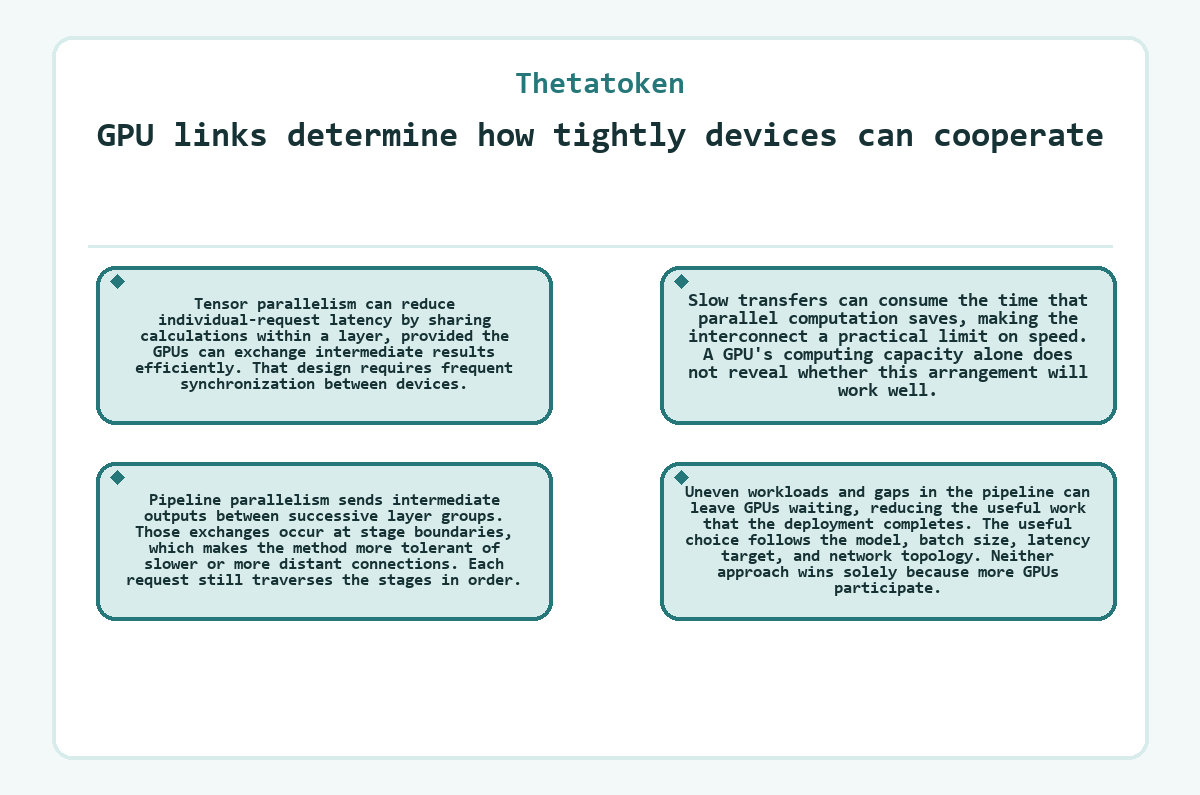
Pipeline parallelism sends intermediate outputs between successive layer groups. Those exchanges occur at stage boundaries, which makes the method more tolerant of slower or more distant connections. Each request still traverses the stages in order. Uneven workloads and gaps in the pipeline can leave GPUs waiting, reducing the useful work that the deployment completes.
The useful choice follows the model, batch size, latency target, and network topology. Neither approach wins solely because more GPUs participate.
Why can a model fit across GPUs and still respond slowly?
Distributing model layers can solve a memory constraint while leaving communication delays and sequential stage execution in place. GPU memory, also called VRAM, determines what each device can hold. The serving runtime must also accommodate working memory, including the key-value cache that grows with context length.
In a hypothetical deployment, the selected model and its runtime memory exceed each GPU's capacity but fit across a pipeline. Assume the linked community nodes successfully generate a response, although its arrival is slower than expected.
Pipeline parallelism explains why generation succeeds: each node holds the layer group assigned to it. Intermediate outputs pass between those stages in order. Slow links or an overloaded stage can extend the wait, even when the memory split works.
Successful generation establishes feasibility for the assumed configuration. Comparing its speed requires a baseline under equivalent conditions. A longer context consumes additional cache memory, so the same placement may then need different capacity.
Response timing separates waiting from GPU computation
Latency describes how long a request takes, while throughput describes the inference work that a service completes over time. Increasing capacity for concurrent requests can improve throughput without shortening every response. A meaningful comparison needs the same model, input lengths, output lengths, and request load.
A language-model response has an initial wait and a generation phase. Time to first token records how quickly output begins; subsequent generation speed describes how quickly it continues. Long-prompt handling can affect the first measure differently from the second. Reporting only a total duration can hide that distinction, particularly when the number of generated tokens changes.
NVIDIA Triton's Model Analyzer reports separate timings for scheduling queues, inference computation, and input or output transfers. These measurements distinguish waiting for a model instance from the time spent executing its calculations. End-to-end latency includes the request's full path, so an isolated compute timing cannot stand in for the whole response.
Prefill and decode place different demands on the network
Prefill/decode disaggregation places prompt processing and token generation on separate GPU pools. Prefill processes the input and builds the key-value cache. Decode reuses that cache as it produces the response one token at a time. Transferring the cache between pools becomes an important communication cost.
Theta Labs described a benchmark of this architecture on 19 May 2026 using a 235-billion-parameter model. The configuration allocated four GPUs to prefill and four to decode across two H200 servers. A high-speed link connected the pools. This differs from the community-node Qwen3-32B pipeline: one division separates inference phases, while the other assigns model layer groups to devices.
Theta Labs reported nearly unchanged time to the first word as prompts grew from 1000 to 4000 words. This result applies to the tested hardware and workloads. It does not establish the same behavior for geographically distributed community nodes. The handoff between prefill and decode must be fast enough to justify separating the phases; otherwise communication can consume the benefit of specialized GPU allocation.
GPU utilization shapes the cost of serving
Distributed inference can lower the hardware barrier to serving a model, while coordination and idle stages still contribute to its operating cost. A lower hourly rental rate does not automatically mean lower cost for each completed response. More devices can add scheduling overhead, network transfers, and unused capacity.
The relevant relationship is between the resources that the deployment consumes and the useful output that it delivers. Comparisons also need equivalent response requirements: a configuration that generates longer answers performs more output work. Memory savings therefore answer only part of the cost question, alongside the time and capacity needed to serve the workload.
On-demand Model APIs provide access without provisioning a dedicated server. Dedicated deployments offer a different route for tuning performance and latency. These access choices sit above the hardware arrangement; choosing an interface alone does not specify a parallelism strategy.
TFUEL supports compute-related payments, while THETA staking secures the blockchain. Inference costs still depend on the hardware and communication resources needed to meet response-time requirements.
Thetatoken questions worth asking
-
Can distributed inference use complete model replicas instead of splitting layers?
- Replicated model instances can serve separate requests without dividing each request across model layers. This is a different way to distribute the workload from tensor or pipeline parallelism. Each replica needs sufficient memory for its model and runtime state. Replication addresses concurrent demand when a model fits within each instance; it does not solve a memory shortfall inside an individual replica.
-
What does FP8 change in EdgeCloud's Qwen3-32B deployment?
- FP8 reduces the memory needed to store Qwen3-32B's weights compared with its higher-precision BF16 form. EdgeCloud's documented Parallax deployment uses FP8 to make distributing the model across consumer GPUs practical. Precision and parallelism address related constraints: one reduces the weight footprint, while the other divides the model among devices. Available memory must still accommodate runtime state, including the generation cache. Reduced precision can also involve serving-stack compatibility and output-quality tradeoffs.
-
Are community GPU pipelines equivalent to an EdgeCloud GPU cluster?
- EdgeCloud GPU clusters group GPU Nodes of the same type in one region with direct communication. Parallax's community pipelines can include nodes with different hardware, availability, and locations. The network topology and the inference configuration still determine how those devices cooperate; a shared region alone does not establish their response speed.
-
How can tensor and pipeline parallelism work together in an inference deployment?
- A compatible serving stack can combine tensor parallelism within layer groups with pipeline parallelism between successive groups. GPUs inside a group exchange partial layer results, while the pipeline passes intermediate outputs between groups. The combination requires software support and a GPU arrangement that can sustain both communication patterns. EdgeCloud's described Qwen3-32B service uses Parallax pipelines; support for other serving architectures remains specific to the deployment.
-
Does distributed inference update the information that a Theta AI agent uses?
- Distributing inference changes where a model performs calculations, while an agent's knowledge base supplies the information that it retrieves. Theta's customer-service agents use organizational material such as documents, web content, and live data. Synchronizing that material addresses information freshness. Adding GPUs or changing parallelism does not itself refresh the agent's knowledge base.